
Table of Contents
- What Happens After a Foreclosure Notice: The Full Timeline
- From Mortgage Default to Notice of Intent to Foreclose
- Loss Mitigation Options You Can Request from Your Loan Servicer
- Loan Modification After Foreclosure Notice: What You Need to Know
- How to Stop Foreclosure Before the Auction Date
- Foreclosure Sale, Eviction, and the Redemption Period
- Foreclosure Timeline by State: Key Differences to Know
- What Happens After Foreclosure Notice: Your Recovery Roadmap
Last Updated: June 9, 2026
Understanding what happens after foreclosure notice is one of the most urgent questions a homeowner can face, and the answer depends heavily on your state, your loan servicer, and how quickly you act. The single biggest mistake we see is waiting too long to understand the timeline. A foreclosure notice is not a final verdict, it is the beginning of a legally structured process that, in most states, gives you months to respond, negotiate, or sell.
What Happens After a Foreclosure Notice: The Full Timeline
A foreclosure notice marks the formal start of your lender’s legal effort to recover the property, but the process unfolds in stages over weeks or months. It means the clock has started, and your choices narrow with each passing week.

Foreclosure follows one of two legal tracks: judicial or non-judicial. In judicial states, the lender must file a lawsuit, adding time and negotiation opportunities. In non-judicial states, the process moves faster without court involvement.
(/blog/foreclosure-timeline-for-homeowners/)]
The typical sequence runs from a missed payment to a breach letter, then a notice of default, then a summons or sale notice, and finally an auction date. Each stage carries specific legal rights and deadlines.
Judicial vs. Non-Judicial Foreclosure: Which Process Applies to You
In a judicial foreclosure state, your lender files a summons and complaint with the court, giving you the right to respond. In a non-judicial foreclosure state, the lender follows a deed of trust and proceeds through a trustee without a judge.
According to CFPB mortgage servicing guidance, lenders must follow specific procedural rules before initiating foreclosure regardless of state type. Confirm which system governs your loan with a housing counselor or legal counsel.
The 120-Day Rule: Your Built-In Buffer Before Formal Action
The 120-day rule is a federal regulation prohibiting loan servicers from initiating foreclosure until a borrower is more than 120 days delinquent. It applies to most residential mortgage loans and gives homeowners a meaningful window to pursue loss mitigation before formal action begins.
This buffer is a legal requirement, not a courtesy. If your servicer initiates foreclosure before the 120-day mark, that is a violation you can raise with a housing counselor or attorney.
From Mortgage Default to Notice of Intent to Foreclose
Mortgage default is the trigger for everything that follows, typically after 30 to 90 days of delinquency. Servicers are required to make contact attempts, assign a single point of contact, and provide written information about loss mitigation before proceeding.
What the Breach Letter Means and Your Right to Cure
The breach letter is the lender’s formal written warning that you are in default and that foreclosure will begin unless you cure the default within a specified period, typically 30 days. The right to cure means you can stop the foreclosure by paying the overdue amount plus fees within that timeframe. If you cannot pay in full, this is the moment to contact your servicer about loss mitigation options.
Do not ignore a breach letter. Missing the cure deadline accelerates the timeline significantly, and options available at this stage may no longer be accessible once a notice of default is filed.
Notice of Default, Summons and Complaint, and Order to Docket
After the cure period expires, the lender files a formal notice of default in non-judicial states, or a summons and complaint in judicial states. In Maryland and some other states, this is called an order to docket, which officially places the case on the court’s foreclosure docket.
Once a summons and complaint is filed, you have a legal right to respond. A default judgment can be entered against you if you do not respond within the required timeframe, typically 20 to 30 days. This is the stage where engaging legal counsel becomes critical.
Loss Mitigation Options You Can Request from Your Loan Servicer
Loss mitigation is any arrangement between a borrower and their loan servicer that avoids foreclosure. Federal regulations require servicers to evaluate a complete loss mitigation application before proceeding with a foreclosure sale. The key word is "complete", a partial application does not trigger the same protections. Work with a HUD-approved housing counselor to ensure your submission is thorough.
Forbearance, Reinstatement, and Short Sale Explained
Forbearance is a temporary pause or reduction in mortgage payments for borrowers facing short-term hardship. It defers what you owe; at the end of the period, you will need a plan to repay the missed amounts.
Reinstatement means paying the full overdue balance, including fees, in a lump sum to bring the loan current. It immediately stops the foreclosure process and is the cleanest solution when funds are available.
Short sale allows you to sell the property for less than the outstanding mortgage balance with lender approval. It avoids foreclosure on your credit record and often eliminates deficiency judgment risk. Starting early matters, since lender approval takes time.
Contact your servicer’s single point of contact directly and request a written list of all loss mitigation options you qualify for. Servicers are required to provide this, and having it in writing protects you throughout the process.
Loan Modification After Foreclosure Notice: What You Need to Know
Loan modification permanently changes your mortgage terms, interest rate, loan term, or principal balance, to make payments more affordable. Servicers are prohibited from proceeding with a foreclosure sale while a complete loan modification application is under review, known as dual tracking protection under CFPB rules.
The first denial is not always the final answer. You can appeal, submit additional documentation, or request escalation to the mortgage investor. According to HUD’s mortgage assistance resources for homeowners, free HUD-approved housing counselors can help you prepare and submit a complete application at no cost.
How to Stop Foreclosure Before the Auction Date
Stopping foreclosure before the auction date is achievable at almost every stage, but available tools narrow as the sale date approaches. The most reliable options include:
- Submitting a complete loss mitigation application, which triggers a hold on the sale
- Filing for bankruptcy protection, which creates an automatic stay
- Selling the property before the auction date through a traditional sale or to a cash buyer
- Requesting foreclosure mediation, which requires the lender to negotiate in good faith
- Paying the reinstatement amount in full before the sale date
My Foreclosure Options specializes in helping homeowners structure a property sale before the auction date, connecting them with cash buyers who can close quickly and protect whatever equity remains.
Foreclosure Mediation Process and How to Request It
Foreclosure mediation is a structured negotiation between borrower and lender, overseen by a neutral mediator, before a sale is finalized. Many states have mandatory programs requiring lenders to participate when a homeowner requests it.
To request mediation, file a request form with the court or state housing agency within a specified deadline after receiving the summons and complaint. Missing that deadline forfeits your right to mediation in most states. Mediation requires the lender to bring a decision-maker and negotiate in good faith, many borrowers reach loan modifications or short sale agreements through this process that they could not achieve through servicer contact alone.
Avoiding Foreclosure Rescue Scams While Seeking Help
Foreclosure rescue scams target homeowners in distress with promises of guaranteed loan modifications or deed transfer arrangements that claim to save the home, often charging large upfront fees and delivering nothing.
Red flags include any company that asks you to sign over your deed, guarantees a specific outcome before reviewing your documents, or tells you to stop communicating with your servicer. Use only HUD-approved housing counselors or licensed attorneys. The CFPB’s guide to avoiding foreclosure scams provides a current list of verified resources.
Foreclosure Sale, Eviction, and the Redemption Period
Once a foreclosure sale date is set and no resolution has been reached, the property goes to auction. Once the gavel falls, your options contract sharply.
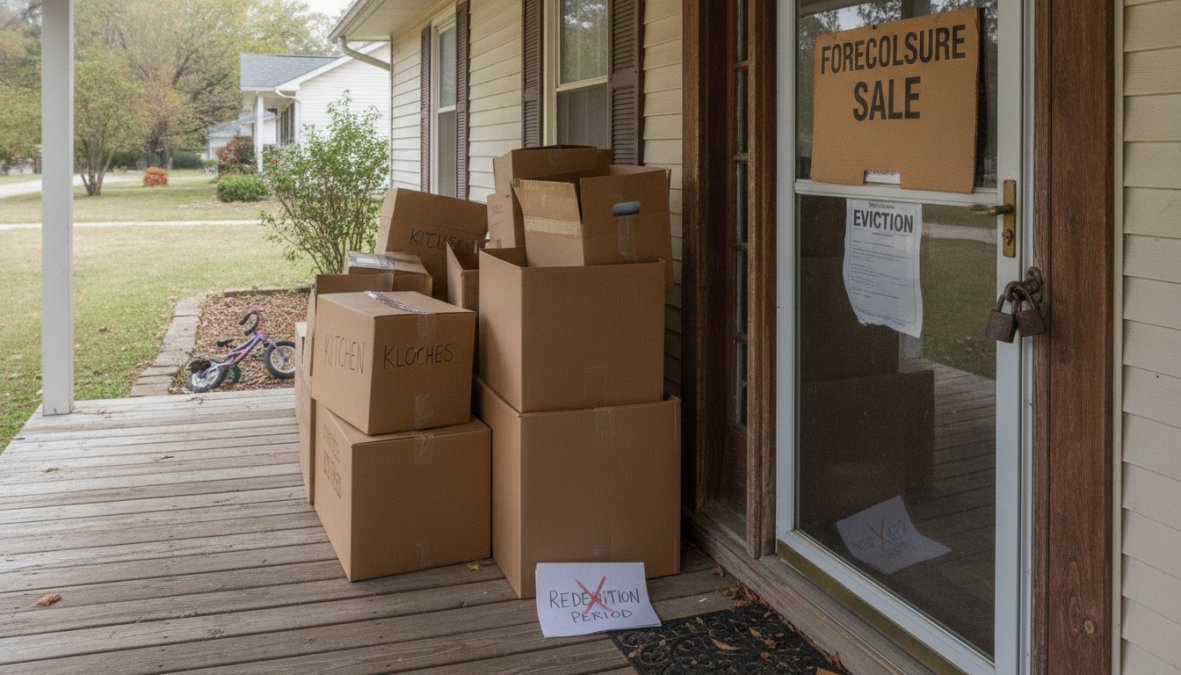
Many states provide a redemption period after the sale, and the eviction process follows a legal timeline that gives former homeowners additional time to transition.
What Happens at the Foreclosure Auction
At a foreclosure auction, the property is sold to the highest bidder, either a third-party buyer or the lender through a bank-owned (REO) acquisition. Homeowners who still occupy the property do not lose possession instantly; the new owner must still follow the legal eviction process.
The Eviction Process and Cash for Keys Agreement
The eviction process after foreclosure follows standard landlord-tenant law. The new owner must provide formal written notice, observe required waiting periods, and obtain a court order before law enforcement can remove occupants.
A cash for keys agreement is an alternative many new owners prefer: the former homeowner agrees to vacate by a specific date and leave the property in good condition in exchange for a cash payment. This avoids the cost of formal eviction for the new owner and gives the former homeowner a financial cushion for relocation.
Deficiency Judgment Risk After the Sale
A deficiency judgment requires a borrower to pay the difference between the outstanding mortgage balance and the foreclosure sale price. Not all states allow them, and some require lenders to pursue them within a specific timeframe. Negotiating a deficiency waiver as part of a short sale or deed in lieu of foreclosure agreement can protect you from years of ongoing financial liability.
Foreclosure Timeline by State: Key Differences to Know
The foreclosure timeline by state varies dramatically. Judicial states like New York and New Jersey can take over a year from first notice to auction. Non-judicial states like Texas and Georgia can complete the process in as little as 60 to 90 days from the notice of default.
| State Type | Example States | Typical Timeline | Court Involvement |
|---|---|---|---|
| Judicial | New York, Florida, Illinois | 12-24+ months | Required |
| Non-Judicial | Texas, California, Georgia | 60-180 days | Not required |
| Hybrid | Virginia, Maryland | 3-12 months | Partial |
The HOPE Hotline, reachable through HUD’s housing counselor locator, connects homeowners with state-specific counselors who understand local timelines and deadlines.
The foreclosure timeline by state is the single most important variable in determining how much time you have to act. Homeowners in non-judicial states who wait for a formal summons may have already lost most of their response window.
What Happens After Foreclosure Notice: Your Recovery Roadmap
The aftermath of a foreclosure notice, whether you stopped it or went through the full process, requires a deliberate recovery plan covering your finances, credit, and wellbeing. This is the part most guides skip entirely.
Financial Document Checklist Before You Meet with Anyone
Walking into a meeting without your documents prepared wastes time and weakens your position. Gather these before any conversation:
- Most recent mortgage statement showing current balance and payment history
- All foreclosure-related notices received, including dates
- Last two years of federal tax returns
- Last 60 days of pay stubs or proof of income
- Last three months of bank statements for all accounts
- Most recent property tax bill and homeowner’s insurance declaration
- Any correspondence from your loan servicer about loss mitigation
- A written summary of your hardship and what changed since the loan was originated
Having this package ready signals seriousness and accelerates every conversation that follows.
Post-Foreclosure Credit Recovery and Mental Health Support
Post-foreclosure credit recovery is a process, not an event. A foreclosure typically remains on a credit report for seven years, but its impact diminishes as you rebuild positive payment history. Many people qualify for a new mortgage within two to four years, depending on loan type and circumstances.
The psychological impact of foreclosure is real and documented, housing instability is consistently linked to elevated stress and family strain. Reaching out to a mental health counselor or community support group alongside practical steps is a recognition that recovery is multidimensional.
The National Foundation for Credit Counseling’s homeownership resources offers free and low-cost counseling for post-foreclosure financial recovery. Practical credit recovery steps include:
- Pull your credit report and dispute any errors related to the foreclosure
- Open a secured credit card and pay it in full each month
- Keep all other existing accounts current without exception
- Avoid new hard inquiries for at least six months after the foreclosure is finalized
- Work with a HUD-approved counselor to create a 24-month credit rebuilding plan
Facing a foreclosure notice is genuinely one of the most disorienting financial experiences a homeowner can go through, and the timeline moves faster than most people expect. My Foreclosure Options provides confidential, no-pressure assistance to homeowners nationwide, helping you explore every available strategy, connect with cash buyers for a fast property sale, and protect your equity and credit before the auction date arrives. Founded by retired U.S. Navy veteran Chad Overly, the team brings 22 years of service-driven discipline to one of the most stressful situations a family can face. Check My Options today to get a quick review of your specific situation and understand exactly what options remain available to you.
Frequently Asked Questions
Does a foreclosure notice mean I have to leave my home immediately?
No. Receiving a foreclosure notice does not mean you must vacate immediately. What happens after a foreclosure notice is a formal legal process that typically takes several months to over a year depending on your state. You generally remain in the home through the foreclosure sale and, in many states, through a redemption period afterward. You are only required to leave after a court-ordered eviction following the completed sale.
Can I stop a foreclosure after receiving a notice?
Yes, you have several options to stop foreclosure after receiving a notice. You can request loss mitigation from your loan servicer, apply for a loan modification, enter forbearance, pursue foreclosure mediation, or sell the property before the auction date. The CFPB requires servicers to evaluate you for these options before proceeding. Acting quickly and contacting a HUD-approved housing counselor or reaching out to My Foreclosure Options can help you identify the best path forward.
How long does the foreclosure process take after the initial notice?
The foreclosure timeline varies significantly by state. Judicial foreclosure states like New York or Florida can take 12 to 24 months or longer. Non-judicial foreclosure states like California or Texas may move faster, sometimes in 3 to 6 months. The 120-day rule under CFPB guidelines also prevents your loan servicer from starting formal foreclosure proceedings until you are at least 120 days delinquent, giving you a window to explore alternatives.
What is a cash for keys agreement and should I consider it?
A cash for keys agreement is an arrangement where the new property owner, typically the bank or investor who purchased at auction, offers you a cash payment in exchange for vacating the home by an agreed date and leaving it in good condition. It can be a practical option if the foreclosure sale has already occurred, as it avoids a formal eviction on your record and gives you moving funds. Always review any agreement with legal counsel before signing.
Will a foreclosure notice permanently ruin my credit score?
A completed foreclosure can significantly lower your credit score and remain on your credit report for up to seven years. However, it does not ruin your credit permanently. Many homeowners begin rebuilding credit within two to three years through on-time payments, secured credit cards, and responsible credit use. Stopping the foreclosure before the sale, through a loan modification, short sale, or selling the property, causes considerably less long-term credit damage than a completed foreclosure.
This article was written using GrandRanker