
Table of Contents
- What to Do First If You Need Urgent Foreclosure Help for Veterans
- How to Contact Your VA Loan Technician for Help
- VA Loan Modification Requirements and Loss Mitigation Options
- Emergency Financial Assistance for Veterans Facing Foreclosure
- SCRA Protections and Your Rights as a Servicemember
- How Foreclosure Affects Your Credit, Equity, and Future VA Benefits
- Foreclosure Scams Targeting Veterans, and How to Avoid Them
- Managing the Mental and Emotional Toll of Urgent Foreclosure Help for Veterans
Last Updated: June 5, 2026
If you have a VA-guaranteed loan and you’re falling behind on mortgage payments, the clock moves faster than most people realize. Urgent foreclosure help for veterans is available right now through federal programs, VA-specific resources, and private organizations like My Foreclosure Options, founded by retired U.S. Navy veteran Chad Overly with 22 years of service. The programs that exist today are genuinely effective. The problem is that most veterans either don’t know about them or wait too long to act. Below, we’ll show you exactly how to move through each stage of the process, from document preparation to scam avoidance, so you can protect your home, your equity, and your credit.
Loss mitigation is the term servicers and the VA use to describe the range of options available to a delinquent borrower before foreclosure becomes final. The options are real, but they require early, proactive engagement. Every week of delay narrows your choices.
What to Do First If You Need Urgent Foreclosure Help for Veterans
Stop avoiding the problem and start building a paper trail. Financial distress creates paralysis, and paralysis is the one thing that works against you here.
Contact your mortgage servicer within the first 30 days of a missed payment. Federal law requires servicers to inform you of available loss mitigation options, and the VA has its own oversight layer that gives you additional protections. The earlier you make contact, the more tools remain on the table.

Step-by-Step Document Preparation Checklist
Most veterans underestimate how much documentation is required when requesting foreclosure prevention assistance. Arriving unprepared delays everything by weeks.
Gather these documents before you make your first call:
- Last two years of federal tax returns
- Two most recent pay stubs (or proof of disability income, pension, or VA benefits)
- Most recent bank statements (two to three months)
- Current mortgage statement showing outstanding balance
- Proof of any additional debts (credit cards, auto loans, medical bills)
- A written hardship letter explaining your financial situation and how it developed
- Any correspondence already received from your servicer or the VA
- Documentation of any assets (retirement accounts, secondary property)
- Military discharge papers (DD-214) if relevant to benefit verification
A hardship letter is not optional. Servicers and VA loan technicians use it to determine which loss mitigation program fits your situation. Keep it factual, specific, and under one page.
Write your hardship letter before you call your servicer. Servicers are more likely to fast-track your application when you can immediately email supporting documentation during or after the initial conversation.
How to Contact Your VA Loan Technician for Help
Every veteran with a VA-guaranteed loan has access to a VA loan technician through their regional loan center, one of the most underused resources in the entire VA Home Loan Program, and it costs nothing to use.
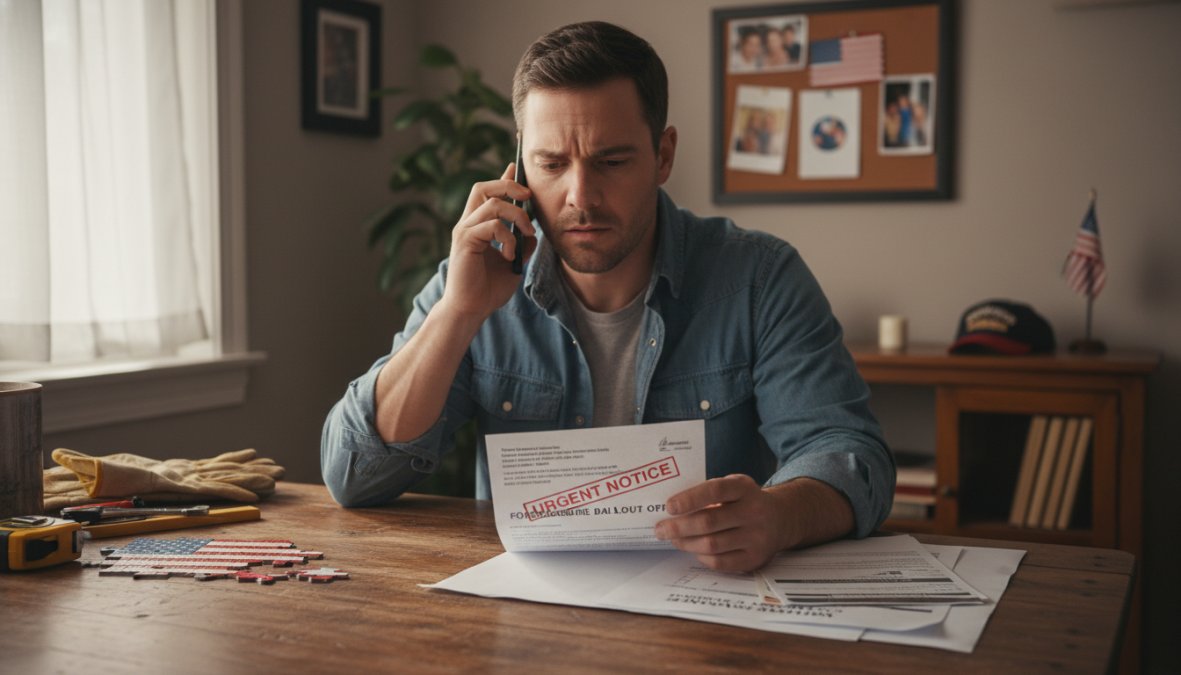
Your regional loan center can be reached through the VA Regional Loan Centers contact directory. VA loan technicians act as intermediaries between you and your mortgage servicer. They do not replace your servicer, but they can apply pressure, clarify your rights, and help identify which loss mitigation options apply to your loan.
What to Say When You Call Your Mortgage Servicer
A common mistake is calling without a clear script. Servicer representatives handle hundreds of calls daily, and if you don’t ask for the right department or use the right terminology, you may get routed to a general line that cannot help you.
Use this framework when you call:
- Ask specifically for the loss mitigation or foreclosure prevention department
- State that you have a VA-guaranteed loan and are experiencing financial hardship
- Request a list of all available home retention options in writing
- Ask for the name and direct contact of your assigned case manager
- Confirm the timeline for submitting a complete loss mitigation application
- Ask whether a foreclosure sale date has been set, and if so, when
Write down every name, date, and reference number from the call. Servicer errors happen, and your notes are your only protection if a miscommunication occurs later.
VA Loan Modification Requirements and Loss Mitigation Options
VA loan modification requirements give veterans a structured path back to affordable mortgage payments. A loan modification permanently changes the terms of your original loan, typically by extending the repayment period, reducing the interest rate, or rolling missed payments into the loan balance.
To qualify, you generally need to demonstrate that your hardship is resolved or stabilizing, that you can sustain the modified payment going forward, and that you have exhausted simpler options like a repayment plan. Your servicer submits the modification request to the VA for approval, so the process involves multiple parties.
Special Forbearance and Repayment Plans
Special forbearance is a temporary pause or reduction in mortgage payments, typically the first option offered to veterans who have experienced a short-term hardship such as job loss, medical emergency, or deployment-related income disruption.
A repayment plan spreads missed amounts across future payments in addition to your regular mortgage payment, best when the hardship is resolved and you have enough income to absorb the additional temporary cost.
Neither option is automatically granted. You must apply, submit documentation, and receive written approval before stopping or reducing any payment.
Partial Claim Program, Short Sale, and Deed-in-Lieu
The VA partial claim program allows eligible veterans to receive an interest-free loan from the VA to cover missed mortgage payments, repaid only when the home is sold or refinanced, one of the most borrower-friendly options available.
When home retention is not possible, two primary alternatives exist:
Short sale is a sale of the property for less than the outstanding mortgage balance, with the servicer agreeing to accept the proceeds as full or partial satisfaction of the debt. The VA Home Loan Program Reform Act expanded the circumstances under which a short sale can be approved, and surviving spouses of veterans may also be eligible.
Deed-in-lieu of foreclosure means voluntarily transferring ownership to the servicer in exchange for release from the mortgage obligation. This avoids a formal foreclosure proceeding but has significant implications for your credit history and future VA loan eligibility.
Never stop making mortgage payments without written confirmation of an approved forbearance or modification plan. Verbal agreements with servicers are not enforceable. A missed payment without written approval is simply a missed payment in your credit file.
Emergency Financial Assistance for Veterans Facing Foreclosure
Emergency financial assistance for veterans is available through multiple channels beyond the VA itself. The Consumer Financial Protection Bureau’s mortgage assistance resources provides a searchable database of HUD-approved housing counselors who offer free services. A HUD-approved counselor can review your entire financial picture, help prepare your loss mitigation application, and communicate with your servicer on your behalf.
State-Specific Programs and the Homeowner Assistance Fund
The Homeowner Assistance Fund (HAF) was established to help homeowners facing financial hardship, and many states still have active programs distributing these funds. Eligibility and availability vary significantly by state, so checking your state’s HAF portal directly is essential.
Several states have also created veteran-specific housing assistance programs operating independently of federal programs, some offering grants, others interest-free loans or emergency mortgage payment assistance.
Practical starting points:
- Your state’s housing finance agency website (search "[your state] housing finance agency")
- State veterans affairs offices, which often maintain referral lists for emergency financial assistance
- Nonprofit organizations accessible through the National Council on Aging’s BenefitsCheckUp tool
My Foreclosure Options serves veterans nationwide and can help you quickly assess which combination of federal, state, and private options fits your situation, including connecting veterans with cash buyers when a fast property solution is necessary to stop foreclosure before auction.
SCRA Protections and Your Rights as a Servicemember
The Servicemembers Civil Relief Act (SCRA) is one of the most important legal protections available to active-duty military personnel facing financial hardship, applying to mortgage obligations entered into before active duty service began.
Under the SCRA, servicemembers may be entitled to an interest rate cap on pre-service mortgage debt, protection against foreclosure without a court order during active duty, and the right to request a stay of civil proceedings. These protections do not apply automatically, you must notify your servicer in writing and provide a copy of your deployment orders. The SCRA creates procedural protections and temporary relief; it does not eliminate your mortgage obligation. Servicemembers who believe their SCRA rights have been violated can contact the Department of Justice SCRA enforcement information.
SCRA protections are time-sensitive. If you are about to deploy or have recently returned, contact your servicer immediately with written notice and your orders. Waiting until you return can mean missing the window for the most valuable protections.
How Foreclosure Affects Your Credit, Equity, and Future VA Benefits
A completed foreclosure typically remains on your credit history for seven years, making it significantly harder to qualify for any new mortgage, including another VA-guaranteed loan. The VA does not automatically restore your loan entitlement after a foreclosure, and if the VA paid a claim on your defaulted loan, you may owe the VA money before entitlement is restored.
Equity is the other major loss. A foreclosure auction rarely returns fair market value, that equity gap is simply gone. A short sale or deed-in-lieu, negotiated carefully, often preserves more equity than a completed foreclosure. Veterans who engage loss mitigation within the first 60 days of delinquency have far more home retention options than those who wait until a sale date is set.
Foreclosure Scams Targeting Veterans, and How to Avoid Them
Predatory actors specifically target veterans in financial distress. Foreclosure rescue scams are a documented, ongoing problem, and veterans are disproportionately targeted because of publicly available VA loan records.
The most common scam patterns to recognize:
- Upfront fee demands: Legitimate HUD-approved counselors and VA resources are free. Anyone demanding payment before providing assistance is a red flag.
- "Guaranteed" foreclosure stops: No private company can guarantee a foreclosure will be stopped. Only your servicer and the VA can approve loss mitigation options.
- Deed transfer schemes: Some scammers ask you to sign over your deed temporarily, claiming they will save your home, a mechanism to steal your property.
- Impersonation of government agencies: Scammers send official-looking letters claiming to be from the VA or HUD. Always verify by calling the VA directly at their official number.
Initiate contact yourself using numbers and addresses you find independently, not numbers printed on unsolicited mail or emails. If someone contacts you first claiming to offer foreclosure help, treat it as a scam until proven otherwise.
Managing the Mental and Emotional Toll of Urgent Foreclosure Help for Veterans
The practical steps matter. So does what happens in your head while you’re taking them.
Facing potential loss of your home is one of the most stressful experiences a person can go through. For veterans, that stress often compounds with service-related health conditions, family pressure, and a cultural reluctance to ask for help. Acknowledging that this is genuinely hard is not weakness, pretending it isn’t leads to paralysis and delayed action.
A few things that actually help:
- Tell someone you trust what is happening. Isolation makes the problem feel larger and the options feel smaller.
- Separate the emotional weight from the tactical work. You can be scared and still make the next phone call.
- Use the Veterans Crisis Line if the stress escalates to something more serious. It exists for exactly this kind of pressure.
- Set a daily limit on foreclosure-related tasks. Constant focus without progress creates anxiety; scheduled focus creates momentum.
The veterans who navigate urgent foreclosure help for veterans most successfully are not the ones who feel the least fear, they are the ones who act despite it. Getting clear on your options is the first step, and it is available to you right now.
Facing the threat of foreclosure is one of the most disorienting situations a homeowner can experience, and veterans deserve support that is both knowledgeable and honest. My Foreclosure Options was founded by a retired U.S. Navy veteran and provides confidential, no-pressure guidance to help you explore every available strategy, including connecting you with cash buyers for a fast solution when time is critical. The team can help you protect your equity, structure a realistic timeline, and stop foreclosure before auction. Check My Options today and get a clear picture of what is actually available to you.
Frequently Asked Questions
Does the VA help veterans with foreclosure?
Yes. The VA offers several foreclosure prevention options for veterans with VA-guaranteed loans. Through your regional loan center, a VA loan technician can advocate with your mortgage servicer to explore loss mitigation options such as loan modification, special forbearance, repayment plans, and the partial claim program. The VA's goal is home retention whenever possible, and they can intervene on your behalf even after delinquency has begun. Contact your regional loan center as early as possible for the best outcome.
What are the VA loan modification requirements I need to meet?
To qualify for a VA loan modification, you generally must demonstrate a verifiable financial hardship that caused the delinquency, show that you now have a stable income sufficient to handle modified payments, and be the owner-occupant of the property. Your mortgage servicer will typically require recent pay stubs, bank statements, a hardship letter, and tax returns. Meeting VA loan modification requirements early, before foreclosure proceedings advance, significantly improves your chances of approval and home retention.
How can I stop a foreclosure immediately as a veteran?
To stop a foreclosure immediately, contact your mortgage servicer the same day to request a loss mitigation review, which legally pauses many foreclosure timelines while your application is under consideration. Simultaneously, call your VA regional loan center to request a VA loan technician. If you are active duty, invoke your Servicemembers Civil Relief Act (SCRA) protections. You may also consult a HUD-approved housing counselor for free guidance, or explore a fast property sale to protect your equity before auction.
Are there specific grants or emergency financial assistance programs for veterans facing foreclosure?
Yes. Emergency financial assistance for veterans may be available through the federal Homeowner Assistance Fund (HAF), which many states administer specifically for mortgage delinquency relief. Veterans Service Organizations such as the VFW and American Legion also offer emergency grants. Some states have veteran-specific housing assistance programs through their state housing finance agencies. These funds can cover missed mortgage payments, helping you avoid foreclosure without taking on new debt. Eligibility and availability vary by state, so check your state's HAF portal promptly.
Who can I contact for emergency veteran housing assistance?
Start by calling your mortgage servicer's loss mitigation department directly. Then contact your nearest VA regional loan center, you can find the number on the VA website or call 1-800-827-1000 (TTY available). HUD-approved housing counselors offer free foreclosure prevention counseling and can be found at HUD.gov. Veterans Service Organizations in your area can also connect you with emergency financial assistance for veterans. Acting within days, not weeks, gives you the most options to avoid foreclosure.
This article was written using GrandRanker